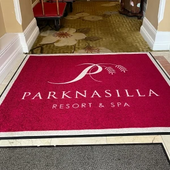
How Many Logo Mats Does a Business Need?
There's no universal number of logo mats suitable for every business, because it depends on how many entrances are actively used, not on the size of the building. A small office with one protected visitor entrance may need only one mat. A shop might need an exterior mat and a separate interior mat at the same doorway. A restaurant could need distinct mats for customers, staff and deliveries, while a hotel or school may need several mats across multiple busy doors.
A simple starting instruction: count every regularly used entrance, assess how each one is used, then decide whether it needs one mat, two mats, or none.
Quantity generally depends on active entrances, customer and staff routes, indoor or exterior conditions, rain and mud, delivery access, cleaning downtime, occasional events, and whether you operate from more than one site.
Quick Answer: How Many Logo Mats Might You Need?
| Business situation | Possible starting quantity | Main consideration |
|---|---|---|
| Small office with one entrance | 1 | One protected visitor route |
| Shop with one street entrance | 1–2 | Outdoor dirt and indoor moisture |
| Restaurant with public and staff doors | 2–3 | Customer, staff and delivery traffic |
| Hotel with lobby and side entrance | 2–4 | Luggage, weather and continuous traffic |
| School with several active doors | One per regularly used entrance | Peak traffic and mud |
| Warehouse with reception and delivery access | 2–4 | Visitor, staff and delivery routes |
| Building with separate entrance and exit | 1–2 | Whether both routes bypass each other |
| Business with several branches | One plan per location | Different layouts and exposure |
| Venue hosting events | Permanent mats plus optional event mat | Temporary traffic routes |
| Business requiring continuous entrance coverage | Main mats plus possible spare | Cleaning and drying time |
These are general planning examples rather than fixed recommendations. Every entrance should be assessed according to how it is actually used.
Count Entrance Zones, Not Just Doors
Building size alone doesn't determine the number of mats you need. A large office may have just one active public entrance, while a small restaurant has separate customer, staff and delivery doors in daily use. A school may open several doors at peak times, and a hotel could have a lobby, side entrance, function entrance and staff door all operating at once.
An active entrance zone is any doorway regularly used by customers, staff, visitors, residents, deliveries or event attendees. Emergency-only or unused doors shouldn't automatically be included; working from active zones keeps the final number realistic.
Use a Simple Formula to Estimate Mat Quantity
Mat Quantity Formula
Starting quantity = active entrance zones + additional indoor moisture-control points + essential cleaning spares
This is a planning framework, not a rigid rule.
Active Entrance Zones
Main customer entrance, secondary public entrance, staff entrance, delivery entrance, side entrance, reception doorway, function entrance, accessible entrance and separate exit count each only where it has a genuine traffic or branding need.
Additional Indoor Moisture-Control Points
An exposed entrance may need an exterior mat to remove mud, grit and debris, plus an interior mat to catch residual moisture and finer dirt. One doorway can genuinely need two mats.
Cleaning and Rotation Spares
A spare may help when an entrance must stay covered continuously, the primary mat needs off-site laundering, drying takes time, hours are long, presentation must continue during cleaning, or winter brings heavy soiling. Not every business needs one.
Step One: List Every Entrance at the Property
Walk the premises and list every door and route: main customer entrance, secondary entrance, staff entrance, delivery doorway, separate exit, accessible entrance, car-park entrance, rear entrance, function-room entrance and internal reception doorway.
| Entrance | Who uses it? | How often? | Exposure | Mat needed? |
|---|---|---|---|---|
| Main entrance | Customers and staff | Daily | Partly exposed | Yes |
| Rear staff door | Employees | Daily | Fully exposed | Assess |
| Delivery door | Suppliers | Several times weekly | Outdoor | Product-specific |
| Side entrance | Occasional visitors | Infrequent | Covered | Review need |
Rarely used entrances generally don't need the same investment as the main doorway.
Step Two: Observe How People Move Through the Building
Mat quantity should follow real traffic, not assumptions. Notice which entrance sees the most people, whether visitors enter and exit through different doors, whether staff use a separate route, and whether a central mat gets bypassed.
Separate Entrance and Exit Doors
One mat may be enough when both routes cross a single adequately sized area, visitors can't bypass it, and the doors sit close together. Two mats may be needed when the doors are genuinely separate, far apart, or expose people to different weather or traffic conditions.
Side-Approach Entrances
Where people approach from the front, left, right or several directions, one well-positioned large mat can sometimes cover every angle; elsewhere, separate mats along each route work better. This is a quantity question, not a full sizing exercise.
Step Three: Decide Whether Each Entrance Needs One Mat or Two
When One Mat May Be Enough
A single suitable mat may work when the entrance is protected, mud isn't a major issue, moisture is limited, the mat covers the walking route, visitors can't bypass it, traffic is low to moderate, and cleaning is regular. This often suits a small office reception, an appointment-only clinic, or an enclosed apartment lobby.
When a Two-Stage Entrance System May Help
Stage one: exterior scraping: the outside mat removes mud, grit, sand, leaves and larger debris. Stage two: indoor moisture control: the inside mat then collects residual water, fine dirt and dust.
This can suit hotels, schools, busy retailers, restaurants, gyms, public buildings, offices beside car parks and apartment developments. It uses two mats at one entrance but isn't necessary everywhere.
How Many Mats Are Needed for Indoor and Outdoor Entrances?
Indoor Entrances
A protected internal entrance may only need one mat where the main issues are residual moisture, fine dirt and reception presentation. Internal logo mats are usually the right choice here.
Outdoor Entrances
An exposed entrance generally needs a mat built for rain, mud, grit, leaves and frequent debris. Exterior logo mats are typically better suited than an indoor-style product.
Partly Covered Entrances
A canopy doesn't automatically make one indoor mat sufficient. Check wind-driven rain, water pooling beneath the mat, saturation, mud from nearby parking, and whether there's room and drying time for a second-stage indoor mat.
Does Every Entrance Need a Branded Logo Mat?
No. Logo mats are usually most valuable at main customer entrances, reception areas, visitor-facing doorways, function entrances, and anywhere branding or photography matters. A plain functional mat may suit low-visibility staff access, utility doors and some delivery points instead. A branded staff or delivery mat can still be worthwhile where visitors occasionally use the door, brand consistency matters, or directional wording would help.
How Many Logo Mats May Different Businesses Need?
Small Offices and Professional Practices
Possibly one mat at the main entrance, a second for a busy staff entrance, or two mats where exterior scraping and interior moisture control are both needed.
Shops and Retail Stores
Possible zones: main entrance, separate exit, staff entrance, delivery entrance and an interior second stage. Doorways don't all need identical branding.
Hotels
Possible locations: main lobby, side entrance, function entrance, restaurant entrance, spa entrance, staff entrance and an interior second stage. Luggage, wheeled traffic and continuous operation add to the case for more coverage.
Restaurants, Cafés and Pubs
Possible locations: main customer door, outdoor seating entrance, staff entrance, delivery doorway and function-room entrance. Grease-exposed and customer-facing areas may need different constructions.
Schools and Colleges
Possible locations: main reception, student entrance, staff entrance, sports-hall entrance, side entrance and an indoor moisture-control point. Morning and afternoon peaks can make some doors more important than others.
Warehouses and Industrial Premises
Possible locations: reception, staff entrance, delivery access, and office-to-warehouse transitions. A logo mat may not suit vehicle routes or every industrial surface.
Apartment Buildings
Possible locations: main resident entrance, secondary entrance, car-park access, reception or concierge area, service entrance and internal lobby.
Multi-Location and Franchise Businesses
Quantity should be calculated separately for each site. Custom logo mats for franchises need to account for different door widths, traffic, exposure, and cleaning facilities from branch to branch; don't simply multiply one branch's order by the total site count without an audit.
| Business type | Possible starting quantity | Reasons for additional mats |
|---|---|---|
| Small office | 1–2 | Staff entrance or weather exposure |
| Retail shop | 1–3 | Exit, staff door or two-stage entrance |
| Restaurant or café | 2–4 | Customer, staff, delivery and outdoor zones |
| Hotel | 3 or more | Lobby, side doors, functions and leisure areas |
| School | One per active entrance | Several peak-traffic routes |
| Clinic | 1–2 | Public and staff entrances |
| Gym | 1–3 | Main entrance, staff access and wet zones |
| Warehouse | 2–4 | Reception, staff and delivery routes |
| Apartment building | 1–3 | Main entrance, car park and lobby |
| Franchise | Site-specific | Different layouts across branches |
These figures are planning examples only. The appropriate quantity should be calculated from the active entrances and conditions at each property.
Should Every Mat Use the Same Design?
Using One Design Throughout the Business
A consistent design can suit retail chains, hotels, corporate buildings and franchises, with easier repeat ordering, recognisable colour use and a more unified experience.
Using Different Designs at Different Entrances
Wording such as Main Entrance, Reception, Staff Only, Deliveries, Welcome, Conference Centre, Restaurant, Spa or Exit can help identify each door; keep it simple and readable.
Matching Indoor and Outdoor Designs
Different materials and production methods can affect colour, texture, detail and logo sharpness, so it's worth reviewing a separate proof for each product type.
Does the Business Need a Spare Logo Mat?
A spare logo mat for cleaning is optional.
When a Spare May Be Useful
Continuous coverage requirements, commercial laundering, slow drying, long operating hours, ongoing branded presentation during cleaning, heavy winter soiling, or event-driven traffic spikes.
When a Spare May Not Be Necessary
Cleaning outside opening hours, quick drying, an alternative entrance available temporarily, low traffic, or suitable matting already on hand.
Branded Spare or Functional Replacement?
Options include a matching branded spare, a plain functional cleaning-day mat, two branded mats in rotation, or a separate seasonal exterior mat base; the choice is based on a genuine need, not habit.
Seasonal and Event Mats
Some businesses need temporary mats for Christmas trading, promotions, exhibitions, launches, conferences, weddings, hotel functions, school open days, outdoor seating periods, or temporary routes during building work. Consider duration, the traffic increase, indoor or outdoor placement, storage, cleaning, reusability and design relevance. A temporary mat still needs to suit its placement and traffic conditions.
One Large Mat or Several Smaller Mats?
When One Large Mat May Be Better
A wide reception, double doors, one concentrated walking route, a hotel lobby, a corporate entrance, or a recessed matwell.
When Several Smaller Mats May Be Better
Separate doors, different walking routes, several entrance zones, limited cleaning equipment, differing indoor and outdoor conditions, or a mat too large to handle easily.
Cleaning and Handling
One large mat gives continuous coverage but can be harder to lift, clean, dry, store and reposition. Several smaller mats are easier to handle but can leave gaps if poorly planned.
How Budget Should Affect Mat Quantity
Prioritise the entrances that matter most rather than spreading a budget across unsuitable mats everywhere:
- Main public entrance
- Highest-traffic entrance
- Most weather-exposed doorway
- Important staff entrance
- Delivery or secondary public entrance
- Internal moisture-control point
- Cleaning spare
- Seasonal or event mat
Balance quantity against traffic suitability, mat size, indoor and outdoor needs, design complexity, cleaning capacity and frequency of use.
Common Mistakes When Calculating Logo Mat Quantity
⚠️ 1. Counting Every Door
Unused or emergency-only doors don't need a mat simply because they exist.
⚠️ 2. Ordering Only for Main Entrance
Staff, side or delivery doors generate real traffic and dirt too.
⚠️ 3. One Mat for Separate Routes
People easily bypass a central mat if entrance and exit are separate.
⚠️ 4. Forgetting Indoor Second Stage
Exterior mats handle mud while leaving residual moisture behind.
⚠️ 5. Identical Quantities for Branches
Each site has a distinct layout, traffic flow, and exposure.
⚠️ 6. Ordering Spares Without Reason
A spare should solve a real operational problem, not just feel reassuring.
⚠️ 7. Ignoring Cleaning & Storage
Large mats can be impractical without facilities to wash and dry them.
⚠️ 8. Choosing Quantity Before Size
One well-sized mat usually outperforms several that don't cover the route.
⚠️ 9. Same Construction Everywhere
Indoor, exposed, greasy and high-traffic zones need different constructions.
Business Entrance Audit Checklist
- Is this entrance used regularly?
- Who uses it? (Public, staff-only, or deliveries)
- Is it indoors, covered, or fully exposed?
- Does rain reach the doorway?
- Is mud, grit, food residue or grease present?
- How heavy is the traffic?
- Are luggage or trolleys used?
- Do people enter and exit through different routes?
- Can visitors bypass the mat?
- Is there room for an outdoor and indoor mat?
- Does the door open over the mat?
- What floor surface is underneath?
- How will the mat be cleaned?
- Is continuous entrance coverage necessary?
- Does the location need customised branding?
- Would directional wording help?
- Is a spare genuinely necessary?
Frequently Asked Questions
Calculating the Right Number of Logo Mats for Your Business
Working out how many logo mats a business needs comes down to a practical process rather than a fixed formula. Count active entrances rather than every doorway, observe how customers, staff and deliveries actually move through the building, and decide entrance by entrance whether one mat is enough or a two-stage system makes sense. Prioritise public-facing and heavily used doors, assess indoor and outdoor conditions separately, and only add a spare mat where cleaning downtime genuinely calls for one.
If you run more than one site, audit each branch individually rather than assuming they're identical, and don't assume every mat needs the same branding. The right quantity is simply the smallest practical number of mats that properly covers your business's important entrance routes, without leaving genuine dirt, moisture, traffic, or branding needs unaddressed.
Need Help Auditing Your Business Entrances?
Contact Logo Mats Ireland to calculate exact sizing, quantity, and custom branding for your property.
Explore Custom Logo Mats